The End of the Parties?

Have we reached a tipping point where ‘first past the post’ finally fails to hold together the two big coalitions that have dominated British politics for nearly a century – the Conservative Party and the Labour Party?

Unknown

Cameron


The Tories are having a great summer: an unexpected (if slim) majority in the General Election; Labour wiped out in Scotland and descending into fratricidal warfare on an epic scale; the economy still (just) looking OK. David Cameron is so ‘chill-laxed’ he’s taken no fewer than 3 summer holidays.

Continue reading “The End of the Parties?”

Varieties of the Democratic State Market?

This is a ‘think piece’ about varieties of what I  call the ‘Democratic State Market’, for reasons I’ll explain below.

I would really welcome discussion on this, as it’s all somewhat speculative at this stage.

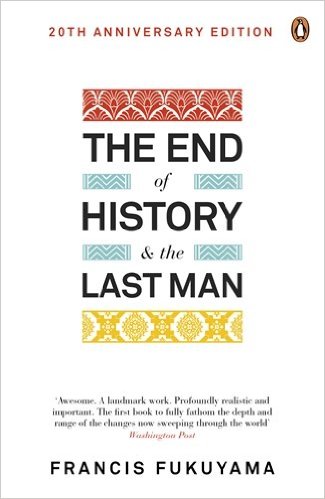
end of historyWhen Francis Fukuyama published his now famous (or infamous, depending on your point of view) initial essay on “The End of History” in 1989 it provoked a furious discussion that continues to this day (the later book version is here). The discussion has been often generated more heat than light, with some of his critics reading things into what he said that just weren’t there. That is perhaps understandable, as he posed fairly fundamental questions about where human society and history is going.

Fukuyama’s mistake (if it was such) was to label the end State of history as the ‘Liberal Democratic’ state. This has been widely taken to mean some version of USA style ‘liberal democracy’ with a relatively small public sector, as opposed to the conservative or social democratic states of Europe with rather larger and more interventionist states. A great deal of energy has been expended proving that there are actually ‘diverse’ (or even divergent) forms of capitalism and welfare states. Continue reading “Varieties of the Democratic State Market?”

What if Labour Can’t Win? Would pre-Election pacts be the answer?

[NB – The data and analysis presented at the end of this post are preliminary, although I am reasonably confident they are about right. I am double checking them myself and with colleagues].

[NB: I have now slightly updated these figures, but the overall picture hasn’t changed much. I have also added the list of seats that would have been vulnerable to a tactical exercise of this sort in a document. Should make interesting reading for the 43 Tory MPs named!]

The entire Labour Party leadership debate is being framed by the question “how can Labour win again?” But what if it can’t?

There are several reasons for believing it might be impossible for Labour to win an outright majority in the House of Commons again, at least for any foreseeable future whoever the elect as their next Leader. And if so, would the alternative be to form electoral pacts before the next General Election? What can the 2015 Election results tell us about what might happen if they did this? Continue reading “What if Labour Can’t Win? Would pre-Election pacts be the answer?”

Parliamentary Arithmetic for Dummies (Tory majority is a bit less slim than it looks)

How big is the Tory majority? Most media commentary keeps getting the real number wrong, and here’s why.

The full results are as follows:

331 Cons

232 Lab

56 SNP

8 Lib Dem

8 DUP

4 SF

11 Others

650 Total

So on these numbers it looks like there are 331 Tories versus 319 “others” – a majority of 12 in a straight vote? No.

The 331 ‘Tories’ include the Speaker (John Bercow) and another Tory who will be elected as one of his deputies.

The 232 Labour includes 2 who will be elected as deputy speakers.

None of the above four vote, so that reduces the Tories to 329 and Labour to 230, and the number of voting MPs to 646.

The 4 Sinn Fein MPs also don’t vote, reducing the number of voting MPs to 642.

So of voting MPs there are 329 Tory MPs and 313 ‘others’ – so their real majority is 16.

So that is 8 by-elections in Tory seats they can lose before they forfeit their majority. There were 21 by-elections during the last Parliament, but if you are a Tory opponent don’t get excited – most of them were in opposition seats (see here). So it is quite likely the Tory majority will, arithmetically at least, hold throughout the Parliament.



The Election may be over, but the fun isn’t.

So what will happen in Britain over the next five years?

If you believed some of the media and Tory triumphalism today you would think they had won a landslide like Tony Blair’s in 1997. They haven’t, and they are probably in for a very bumpy ride indeed. They have had five years of a Coalition with a healthy majority and that had plenty of shunts along the way. Five years of a tiny majority will be that much harder. How long before the Fixed Term Parliaments Act starts getting dusted off and discussed again? Continue reading “The Election may be over, but the fun isn’t.”

So it begins: Last time it was Five Days in May – this time it could be Five Weeks (or more)

It could easily be 5 weeks before we have a settled Government. It might not be, the polls might be wrong or there could be last minute surge in one direction or another, but they could be right.

If the polls are right we are possibly in for a long period of uncertainty before we have a settled Government.

Here’s one of many possible scenarios – you can judge how likely it is: Continue reading “So it begins: Last time it was Five Days in May – this time it could be Five Weeks (or more)”

We need a new language for our new multiparty politics – for example, the Left has almost certainly won this General Election.

Media discussion of the General Election is still couched firmly in two-party language – have the Tories or Labour ‘won’. This is very misleading in our new multi-party politics and we need to start thinking about using different language to talk about who has won and lost.

On the continent, where multi-party politics is the norm, discussion of who won and lost is more often framed in the language of ‘left’ and ‘right’, and then of which parties have gained or lost within each ‘camp’. These camps are lose categories, but useful for thinking about how popular opinion and the outturn in seats has gone. Continue reading “We need a new language for our new multiparty politics – for example, the Left has almost certainly won this General Election.”

Why can’t our national broadcaster get simple stuff right?

image

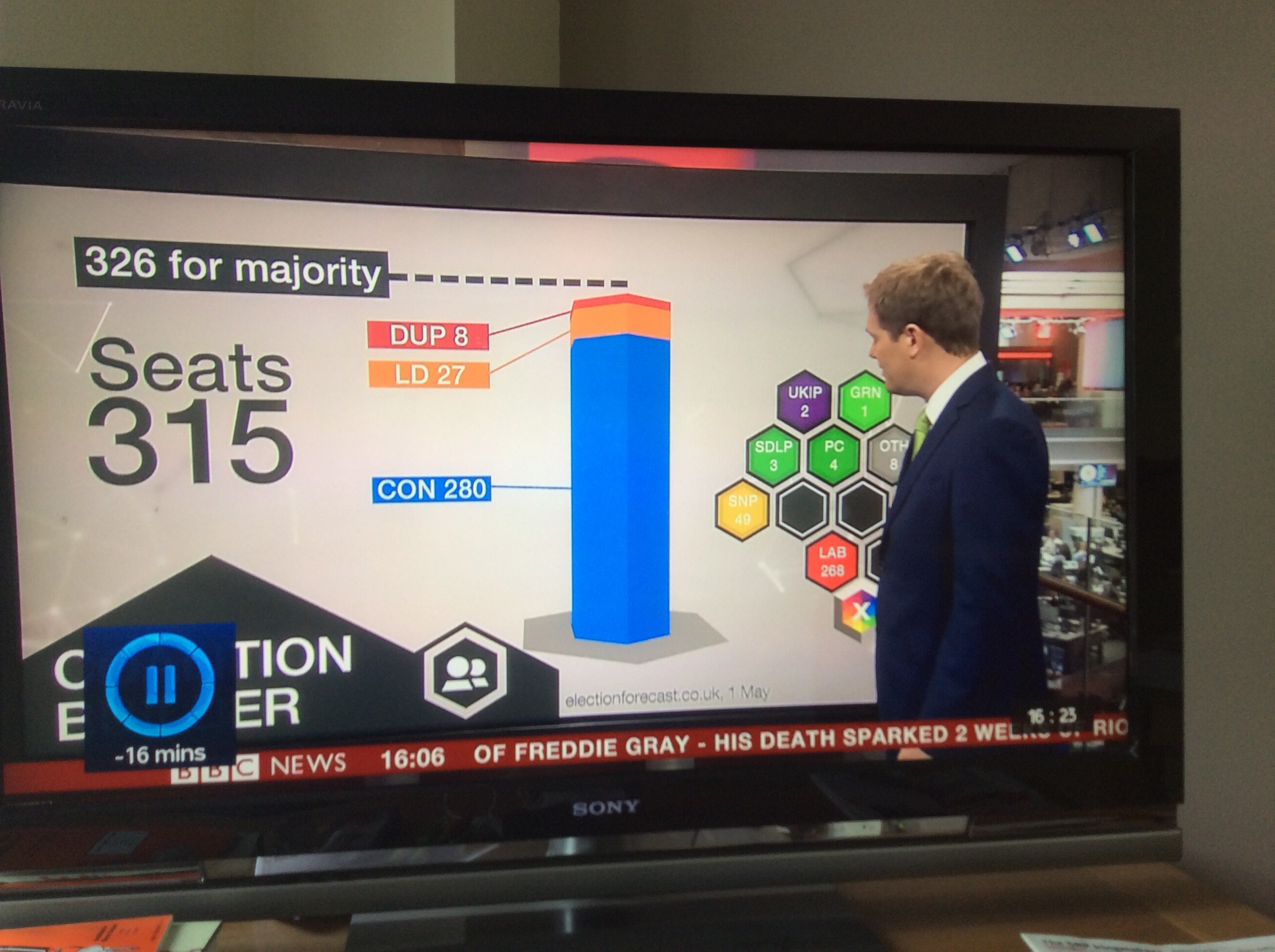
The BBC has been consistently speculating on who can put together a majority after May 7th using a misleading number: 326.

They get to this number of a ‘majority’ government/coalition/deal by simply dividing the number of MPs – 650 – by two, and adding 1 for a majority = 326.

But they must know this is simply wrong.

First, the Speaker, and his/her three deputies all don’t vote – the effective number of voting MPs is immediately reduced to 646, not 650.

Second, Sinn Fein MPs don’t even take their seats, much less vote and there are currently 5 of them and probably will be in the next Parliament. So the number of voting MPs is reduced to 641.

That means the real number of a voting majority is 321, not 326.

Please get it right Auntie Beeb.

[PS – ironically writing this quickly on an iPad led to some initial spelling snafu’s – but at least mine were unintentional – can’t believe the BBC don’t know their number is wrong so why are they doing it?]

“The Fixed Term Parliament Act has absolved all the players from any duty to respect constitutional conventions rather than the letter of the law.” Senior Officer of Parliament

[This post has been modified to remove some comments which colleagues found unnecessarily combative. I have apologised and removed them. I have also taken the opportunity to clarify one or two small points].

I have posted three blogs that have attracted a lot of attention from the media and other commentators – see for example this from Mark Elliott. You can find mine here, here and here (in chronological order of posting). And here’s another contribution from Canada.

I have been criticized for conflating issues of Government and Parliament and law and convention. This is not the case. Continue reading ““The Fixed Term Parliament Act has absolved all the players from any duty to respect constitutional conventions rather than the letter of the law.” Senior Officer of Parliament”

The Fixed Term Parliament Act was designed to protect the (Coalition) Government: don’t be surprised when it protects a Labour one too

Some people have criticised the analysis of the impact on the FTP Act on the power of the executive and accused me of being confused. I am afraid it is they who are confused. Most of their criticism seems to boil down to clinging to old notions of ‘confidence and supply’ and ‘confidence of the House’, notions superseded by the FTP Act.

Lets recall the political circumstances and purposes of the FTP Act. It was conceived by a coalition Government intent on implementing what could be very unpopular austerity policies. They wanted to ensure that they “hung together” lest they “hang separately” for as long as possible – the five years allowed between elections.

They wanted it to be as difficult as possible for (a) them to be turfed out of office and (b) a new election to be forced upon them before their five years was up. Continue reading “The Fixed Term Parliament Act was designed to protect the (Coalition) Government: don’t be surprised when it protects a Labour one too”