Full steam ahead for Brexit – A personal elegy for a cosmopolitanism that perhaps never was

trmdrag's avataraspiration&revolution

Now it is almost official, after 461 to 89 MPs backed the government’s Article 50 Bill yesterday: Brexit will happen probably sooner than many expected, and more authoritarian and undemocratic than ever thought possible by those who believe in due democratic process.

Photo: Stefan Boness, www.iponphoto.com Photo: Stefan Boness, http://www.iponphoto.com

Brexit will in essence be negotiated by a Prime Minister not even elected by ‘the people’ in a real sense, ‘the people’ we hear so much about these days, and whose will the PM now proclaims to carry out. One can have different views on what democracy is, and how democratic a referendum, fought on a single issue and based on false facts (or ‘post-truth’), as later frankly admitted by those who propagated them, really is – and I am among those critical of such versions of democracy.

A remain-politician, before the first vote on Article 50 in parliament, explained why he would vote…

View original post 1,553 more words

EU & Academia: funding matters too – Prof Dame Athene Donald

Another leading physicist, Professor Dame Athene Donald of the Cavendish Laboratory at Cambridge has added her voice and a slightly difimage_normalferent perspective
to the discussion about Universities, academics and Brexit. She told me:
“As a member of the European Research Council Scientific Council I am very aware both of the
success of academics in the UK in obtaining ERC funding and also the
value people place on the ‘portability’ of grants awarded under these
schemes.

Continue reading “EU & Academia: funding matters too – Prof Dame Athene Donald”

The ACBs: the Administrative Consequences of Brexit?

by Colin Talbot and Carole Talbot

Most of the debate around Brexit focuses of the big policy issues.

What tends to get ignored is the impact it will have on the UKs “machinery of government”.

Some of these impacts are fairly obvious, some much less so. Some are purely regulatory, others administrative and some a combination of both. But taken together they amount to a seismic shift in the machinery of British Government. Continue reading “The ACBs: the Administrative Consequences of Brexit?”

Brexit and EU27 academics in the UK – breaking up is hard to do

border-eu-citizens-facebook_social_mediaYou “should now make arrangements to leave” (Home Office)

The UK’s University sector is one of our most valuable national assets” Professor Brian Cox, the University of Manchester academic and TV presenter, told me last week. Brian said that UK higher education “is a genuinely global industry generating billions of pounds in export earnings, one of the necessary foundations of our innovation-led economy and perhaps our strongest soft power asset; political and industrial leaders from all over the world were educated here in the UK.

Which makes it all the more strange why the Government should be, accidentally or deliberately, undermining our Universities. Most of the commentary on Brexit will have on UK Universities has concentrated on issues of funding, research cooperation and students. Much less attention has been paid to what keeps Universities running – academic staff – and what Brexit will mean for the thirty-thousand plus EU academics in the UK. Here are some of their personal experiences and what it means for our Universities.

How this all started for me…. Continue reading “Brexit and EU27 academics in the UK – breaking up is hard to do”

Mobilsing Social Science Research for the Media – The Other Research Bureau?

orb

In a “post-truth” political world, facts have never been more important. Some are easy to find, others require some skill and knowledge to locate and analyse.

Media organizations and journalists are under ever greater pressure to produce sound, fact-based, reporting to counter the tidal wave of fake news and half-truths spread through social media.

They also have less resources to employ their own investigative teams.

There are, however, thousands of well-trained social scientists in the UK – inside and outside of academia – who have the skills and knowledge to unearth the real story. Many young researchers have much to contribute and could always do with a little extra cash. They also can – sometimes – respond quickly to requests. I have worked with several in this way myself.

So, we are thinking of creating a service that brings the demand for quick, efficient, investigative research from media organizations and journalists together with those social scientists who are willing to provide quick but quality access to or digests of the information the media needs. Or, in some cases, to carry out more in-depth investigations?

A sort of “Trust a Trader” or “Rated People” platform for social scientists and the media. We have a preliminary name and logo (above).

We envisage an on-line platform where requests can be made (with a fee offer) and social scientists respond if they can help.

We should stress this would not be investigative journalism – we’ll leave that to the media. This would be background research to help journalists write their stories.

We are interested in hearing from

Media folk if you think this sort of service would be useful and would you or your organizations pay for it?

Social scientists who might want to participate (we’re thinking especially here of early career researchers maybe?) – for payment, obviously.

We want to know if this is a bonkers idea, or something worth trying?

Comments welcome here or directly to me at colin.talbot@manchester.ac.uk 

REVIEW: The many ways in which Brexit can become Wrexit for Britain

img_1935

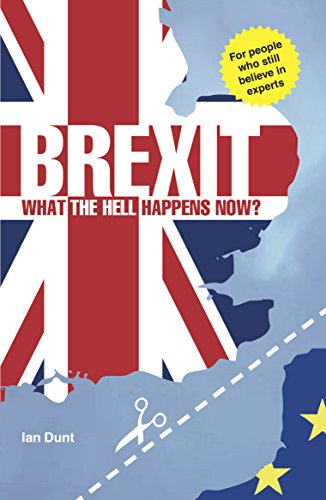
BREXIT – What The Hell Happens Now? Ian Dunt. Canbury Press. 2016 

On June 23rd 2016 British voters delivered a slim majority (52/48) in an advisory Referendum on whether the UK should remain or leave the EU.

What happened immediately afterwards was even more shocking than the actual result (which not even the ‘Leave’ camp had expected). British politics suddenly did a screeching 180 degree U-turn on decades of commitment by both Conservatives and Labour to the EU – “Brexit means Brexit”. The Referendum was transmuted to unchallengeable Holy Writ – the people had spoken.

The problem is, as Ian Dunt’s book admirably sets out, “the people” and that includes most of our politicians, had no real idea of what had just happened and what the consequences would be. Dunt’s book tries to educate us all, in eye-opening and eye-watering detail.

I should say at this point I rarely read non-fiction books from cover to cover. I don’t have the time – as an academic you quickly learn to skim, dip and dive into books to gut them for what’s essential. I read this, all of it.

There is way too much in the book to review fully so I’ll just highlight what were the key “take-aways” (as we now say) for me. Continue reading “REVIEW: The many ways in which Brexit can become Wrexit for Britain”

Sharon Shoesmith, Baby P and ‘Joined-Up’ Children’s Services – another perspective

Today [30th Dec 2016] we have just been treated to a long, uncritical, bordering on indulgent interview with Sharon Shoesmith – the former head of Children’s Services in Haringey – on BBC Radio 4 PM programme. She was in charge at the time of the “Baby P” case.

During the interview Shoesmith was treated as if she was a social worker (she wasn’t) and an expert on child abuse (at the time it was far from evident she knew anything about child abuse).

The interview concentrated almost entirely on what had happened to Shoesmith personally and on her reactions. There were no questions about her personal responsibility for the service she led nor any exploration of the context – the merger of education and children’s social services which later proved to be problematic nationally.

Here is what I wrote about this back in Feb 2009. I hope it throws a bit more light than the PM interview did. Continue reading “Sharon Shoesmith, Baby P and ‘Joined-Up’ Children’s Services – another perspective”

A brief comment on “identity politics”

In a thoughtful and thought-provoking post Chris Creegan discusses the issue of “identity politics” and whether it has “gone too far” as some on the centre-left are now arguing. In the constructive spirit of Chris’s piece here’s my brief comment I posted on his site:

——-

Whilst I understand, and sympathise, with your point of view it seems to me your argument elides two different things.

The first is recognizing the equal rights of people regardless of gender, orientation, colour, etc. this is a fight I have supported all my adult life.

The second is the practice of adopting group identities – “LGTB”, “Black”, “Latino” – as a dominant mode of self-expression. Whilst there may be an argument in favour of this – principally one of solidarity against oppression – it also needs to be recognised that THIS type of “identity politics” is a two edged sword. If the dominant dynamics of society is towards”group identity” don’t be surprised if groups that are much less  progressive start to emerge – national, racial, sexual – as a result.

As a white, male, heterosexual what “identity” can/should I have in a society of “identity” politics? Some resolve this by “identity by association” – white boys with dreadlocks and gansta talk for example. Or seeking out some tenuous link to an oppressed group – e.g. I had two Irish great grandmothers so I can become an Irish Republican? But others will be attracted to other, more dysfunctional, solutions. Look what happened in the dissolution of the former Yugoslavia as ethnic and national identities took hold?

So I am not surprised that in combining a campaign for legitimate RIGHTS with a rather less defensible promotion of IDENTITY politics the former gets eclipsed by the latter. A classical progressive position would be to put all the emphasis on the former, and be very, very cautious about the latter?

Who Does Social Inquiry in the UK?

Our new initiative on Deliberative Public Policy has been launched as a separate blog and resources site. Here’s the first post.

Prof. Colin R Talbot's avatarENGAGE Public Policy

Colin Talbot

16 Nov 2016

A lot of public policymaking is based on at least some form of social inquiry – how do Governments know what is going on in their societies and what do they want to do about it?

With academics and research Councils – especially the Economic and Social Research Council – obsessed at the moment with ‘impact’ of our research, its impact on policy has become a central issue.

Recent national controversies like the “Brexit” debate have – as a side issue – also focussed on the role of “experts”.

View original post 1,119 more words

The Invisible Hand’s Shadow

This article was originally drafted in 2004 but most of the argument is still highly relevant today.

WARNING: longer read

What links the terrorist attacks in the USA on 11th September 2001, the failures of the UK Child Support Agency, and outbreak of “foot and mouth” disease in the UK? The answer is simple – the shadow economy.

Continue reading “The Invisible Hand’s Shadow”