Human Nature: our (four) Human Social Instincts

It is often said that “human’s are social animals” without really thinking what that implies. Many creatures are social, in the sense that they live in groups, but there are wide differences in what ‘social’ means – from the simple semi-chaos of herding for cattle or deer through to the elaborate, regimented, division-of-labour society of the termite or the honey bee.

Continue reading “Human Nature: our (four) Human Social Instincts”

Norman Geras: For Human Nature

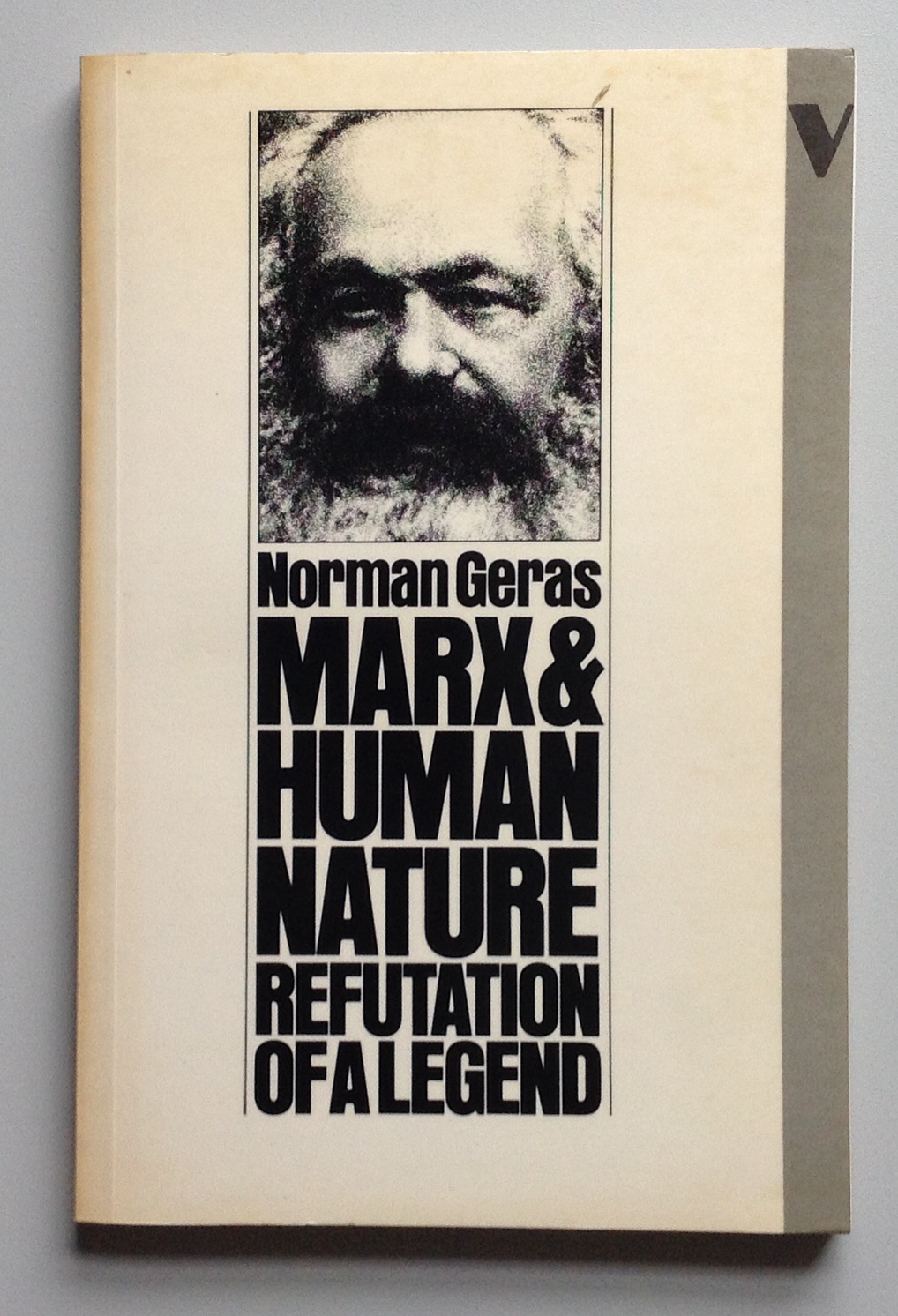
photo-3Norman Geras died today. Many people will never have heard of a retired politics professor from Manchester, who wrote books on obscure German revolutionaries (Rosa Luxemburg) or human nature in Marx. Some may have seen his more recent “NormBlog” or maybe even heard about his support for theIraq war. But Norman’s influence has been profound on many people, including me. I met Norman back in the early 1970s when I joined the International Marxist Group (IMG), the British section of the Trotskyist Fourth International. The Manchester branch of the IMG was a revelation to a working class boy from Barrow – full of powerful intellects like Norman and Ian Gough, and teeming with debate and ideas. I haven’t seen Norman in many years, although we did exchange some emails when I came back to Manchester a few years ago. He’d retired by then and was writing Normblog and I was busy with my academic and domestic life, with a new son to look after. We said we should meet up, but it never happened. When I found out Norman had died this morning my first reaction was to find my copy of one of his books, from 1983. Here’s why: Continue reading “Norman Geras: For Human Nature”

Whitehall Watch has gone, to a better place…

Dear friends, colleagues and readers,

Whitehall Watch has gone – but just to a better place. It has now joined what will be a suite of blogs under the umbrella of Manchester Policy Blogs.

If you have come here (by mistake) then please just click this www.manchester.ac.uk/whitehallwatch and it’ll take you to the new home of Whitehall Watch.

After nearly four years and over 180,000 hits I have to say it’s been a wrench “letting go”.  It has been quite a journey, with more than a few unexpected twists and turns. Above all WW has had far greater impact than I ever thought possible. And reach – it’s extraordinary that its been read in over 140 countries. But, onwards and upwards… so join me and us at our new home.

Colin

Government defeats over public money in Parliament (crowd sourcing examples)

This is an appeal for a bit of research help from Whitehall Watch’s highly knowledgeable readership…..

There is a widespread belief – often repeated  in serious academic texts – that any defeat on ‘budget’ or ‘money’ motions in the House of Commons is tantamount to a vote of no confidence. I’m grateful to Prof Philip Cowley for pointing out this isn’t actually true in practice   – there have been about 20 cases, at least, of defeats since 1918 (see table below) none of which was treated as a vote of confidence. Continue reading “Government defeats over public money in Parliament (crowd sourcing examples)”

Britons say no to smaller state (BSA 30)

By Colin Talbot, University of Manchester

Britain is still a majority social-democratic country. That is, politically, the most significant finding of the latest British Social Attitudes survey published this week. Most people want a country which “gets and spends” about what we do now, or even more, rather than less. The BSA figures seem to contradict the often heard assertion that the British people want Scandinavian levels of public services for American levels of taxes. Continue reading “Britons say no to smaller state (BSA 30)”

Why ‘Homo Janus’?

Why do I use the term “Homo Janus” for this approach to human nature?

It is to contrast this theory of human nature to various others – such as for example the idea of ‘homo economicus’, the rational utility maximising human so beloved by economists. The ‘Janus’ bit is to emphasise the paradoxical, contradictory, nature of human social instincts.

The Roman God Janus is most often depicted as having two faces, but also sometimes as having four (Janus Quadriphons) – see the picture of the four-sided ‘Janus Arch’ in Rome on another page.

As the theories developed here humans have four basic social instincts – H. Janus seems appropriate.

‘Universal Credit’ Crunch Arrives (as I predicted it would)

Today’s NAO Report on Universal Credit implementation is one of the hardest hitting critiques in living memory from a usually restrained institution. I would say “I hate to say I told you so”, but I don’t ‘hate to say it” and I did, three years ago. But first the NAO’s verdict:

“The National Audit Office has concluded that the Department for Work and Pensions has not achieved value for money in its early implementation of Universal Credit. …

Today’s report concludes that the Department was overly ambitious in both the timetable and scope of the programme. The Department took risks to try to meet the short timescale and used a new project management approach which it had never before used on a programme of this size and complexity. It was unable to explain how it originally decided on its ambitious plans or evaluated their feasibility.”

Devastating stuff, but not unexpected, as there’s been a steady trickle of stories about UC’s problems.

So Predictable.

In a post on my own Whitehall Watch and on the ‘Public Finance’ blogsite, in November 2010, I spelt out why the implementation of Universal Credit was likely to be a disaster. I think the broad thrust of what I said then still holds true today.

I have heard some blame being attached to Iain Duncan Smith – the funniest quip I’ve heard is “what do you expect when you send a Lieutenant to do a Generals job?” (a reference to IDS’s undistinguished military service, which he’s always made a lot of). He has certainly suffered from a large dose of hubris about what it is possible to do and on what timescales. Continue reading “‘Universal Credit’ Crunch Arrives (as I predicted it would)”

Limit public service competition to non-profits

Post written by Colin Talbot for The Conversation.

The idea that competition is better than monopoly provision in public services is now established wisdom among the British political elite. Since the advent of something commonly called “New Public Management” in the early 1980s, privately managed organisations have been taken to be more efficient and innovative than public ones.

But is there, to coin a phrase, a third way? Competition without private interest companies? The belief that the private sector is inherently good has meant Continue reading “Limit public service competition to non-profits”

Has the Office for Budget Responsibility achieved genuine independence from government?

Having been established by the government to take the politics out of fiscal and economic forecasting, the independence of the Office for Budget Responsibility is fundamental to its credibility and legitimacy. The appointment of Robert Chote as Chair in 2010 appears to have enhanced the OBR’s standing in this regard, but has not completely swept away all concerns about the OBR’s relationship to government. On the day the OBR releases its latest analysis of the UK’s public finances, Craig Berry and Richard Berry ask whether the agency has yet been able to break free from the political grasp of the Treasury.

The Office for Budget Responsibility (OBR) was established to help ensure the government’s fiscal and economic forecasts are credible and transparent. The key innovation designed to achieve this objective was that the OBR would be independent of the Treasury, and therefore outside direct ministerial control. When Robert Chote was appointed as the second Chair of the OBR in 2010 – an appointment approved by Parliament – it appeared to confirm that the agency would be genuinely independent. Indeed, there is no reason to doubt the impartiality of the OBR’s analysis. The idea that the OBR acts with complete autonomy, however, is highly questionable – it remains a very small organisation, integrated almost seamlessly with the Treasury apparatus. Continue reading “Has the Office for Budget Responsibility achieved genuine independence from government?”

NYT Excerpt: Radical Accounting And The Value Of Ideas

I thought this as interesting enough to share….. especially as an awful lot of public management reform is predicated on trying to replicate in the public sector the sort of outmoded private sector practices discussed below….

July 30, 201312:49 PM

In his New York Times Magazine column this week, Adam Davidson writes about the challenges of measuring productivity in today’s economy. Here’s an excerpt. Continue reading “NYT Excerpt: Radical Accounting And The Value Of Ideas”