
So it begins: Last time it was Five Days in May – this time it could be Five Weeks (or more)

It could easily be 5 weeks before we have a settled Government. It might not be, the polls might be wrong or there could be last minute surge in one direction or another, but they could be right.

If the polls are right we are possibly in for a long period of uncertainty before we have a settled Government.

Here’s one of many possible scenarios – you can judge how likely it is: Continue reading “So it begins: Last time it was Five Days in May – this time it could be Five Weeks (or more)”
We need a new language for our new multiparty politics – for example, the Left has almost certainly won this General Election.

Media discussion of the General Election is still couched firmly in two-party language – have the Tories or Labour ‘won’. This is very misleading in our new multi-party politics and we need to start thinking about using different language to talk about who has won and lost.

On the continent, where multi-party politics is the norm, discussion of who won and lost is more often framed in the language of ‘left’ and ‘right’, and then of which parties have gained or lost within each ‘camp’. These camps are lose categories, but useful for thinking about how popular opinion and the outturn in seats has gone. Continue reading “We need a new language for our new multiparty politics – for example, the Left has almost certainly won this General Election.”

Why can’t our national broadcaster get simple stuff right?

image

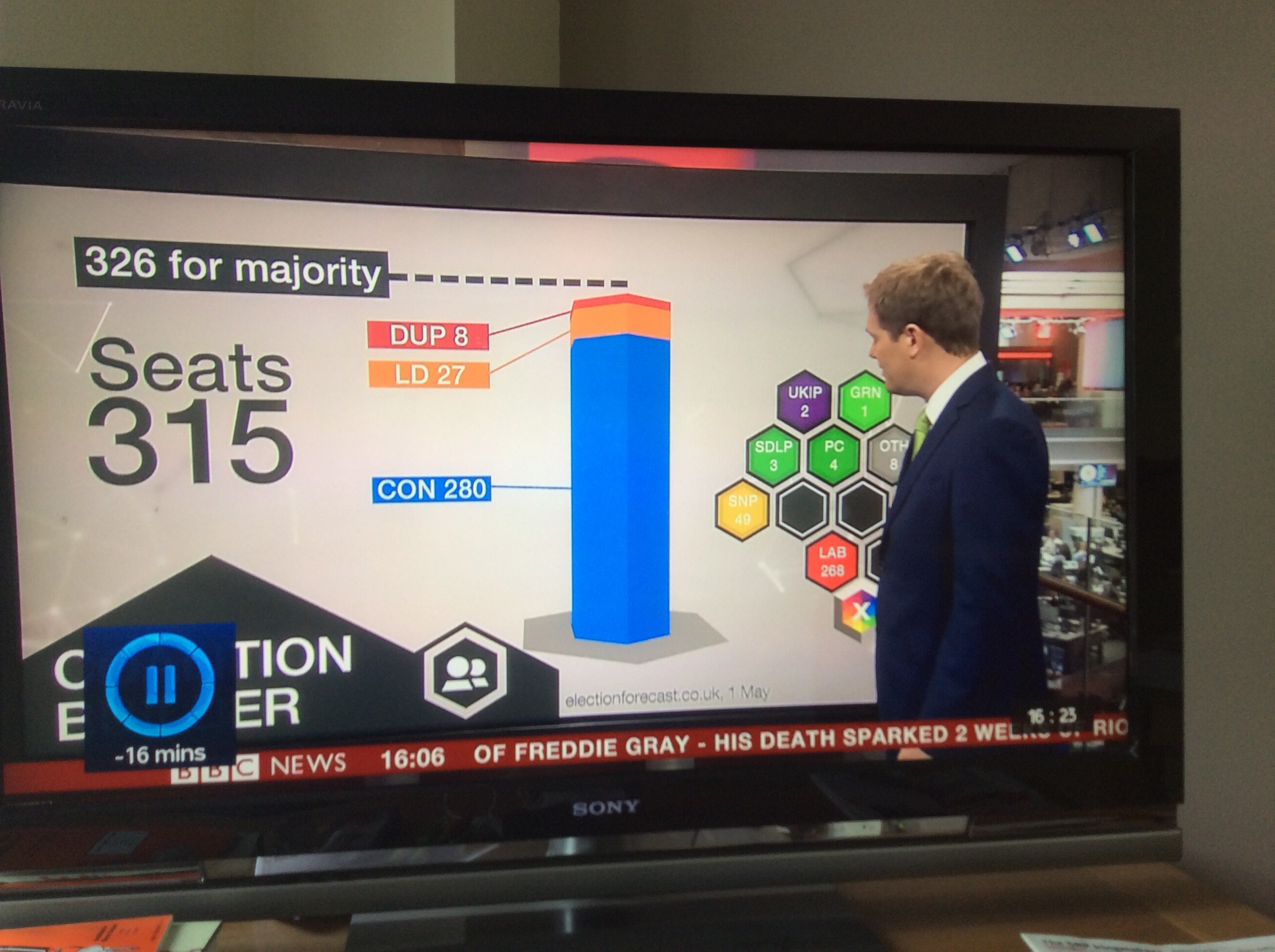
The BBC has been consistently speculating on who can put together a majority after May 7th using a misleading number: 326.

They get to this number of a ‘majority’ government/coalition/deal by simply dividing the number of MPs – 650 – by two, and adding 1 for a majority = 326.

But they must know this is simply wrong.

First, the Speaker, and his/her three deputies all don’t vote – the effective number of voting MPs is immediately reduced to 646, not 650.

Second, Sinn Fein MPs don’t even take their seats, much less vote and there are currently 5 of them and probably will be in the next Parliament. So the number of voting MPs is reduced to 641.

That means the real number of a voting majority is 321, not 326.

Please get it right Auntie Beeb.

[PS – ironically writing this quickly on an iPad led to some initial spelling snafu’s – but at least mine were unintentional – can’t believe the BBC don’t know their number is wrong so why are they doing it?]

Danny Alexander, George Osborne and who ‘commissioned’ welfare cuts proposals – an object lesson in how to be economical with the actualité

I just heard Mr. George Osborne once again peddling his line that the documents revealed by his former Treasury buddy Danny Alexander were in fact “commissioned by the Chief Secretary himself”. This make it sound like Alexander was actually responsible for the proposals for draconian welfare cuts which he says came from Tories. It has worked enough to be repeated by plenty of journalists. Continue reading “Danny Alexander, George Osborne and who ‘commissioned’ welfare cuts proposals – an object lesson in how to be economical with the actualité”

“The Fixed Term Parliament Act has absolved all the players from any duty to respect constitutional conventions rather than the letter of the law.” Senior Officer of Parliament

[This post has been modified to remove some comments which colleagues found unnecessarily combative. I have apologised and removed them. I have also taken the opportunity to clarify one or two small points].

I have posted three blogs that have attracted a lot of attention from the media and other commentators – see for example this from Mark Elliott. You can find mine here, here and here (in chronological order of posting). And here’s another contribution from Canada.

I have been criticized for conflating issues of Government and Parliament and law and convention. This is not the case. Continue reading ““The Fixed Term Parliament Act has absolved all the players from any duty to respect constitutional conventions rather than the letter of the law.” Senior Officer of Parliament”

The Fixed Term Parliament Act was designed to protect the (Coalition) Government: don’t be surprised when it protects a Labour one too

Some people have criticised the analysis of the impact on the FTP Act on the power of the executive and accused me of being confused. I am afraid it is they who are confused. Most of their criticism seems to boil down to clinging to old notions of ‘confidence and supply’ and ‘confidence of the House’, notions superseded by the FTP Act.

Lets recall the political circumstances and purposes of the FTP Act. It was conceived by a coalition Government intent on implementing what could be very unpopular austerity policies. They wanted to ensure that they “hung together” lest they “hang separately” for as long as possible – the five years allowed between elections.

They wanted it to be as difficult as possible for (a) them to be turfed out of office and (b) a new election to be forced upon them before their five years was up. Continue reading “The Fixed Term Parliament Act was designed to protect the (Coalition) Government: don’t be surprised when it protects a Labour one too”

Why don’t you f*** off to Russia – an academic response on housing

The debate about rent controls prompted me to recall the following:

When I was an undergarduate at Manchester in 1975 I had an interesting exchange during an economics seminar. Continue reading “Why don’t you f*** off to Russia – an academic response on housing”

Who Governs Britain After May 7th?

The media is rife with speculation about who will do deals with whom after May 7th and what the possibilities are. What is obvious is that most of them are working on old assumptions about how Governments are formed which predate the Fixed Term Parliament Act 2011 (FTPA), which has fundamentally changed the way these things work.
Continue reading “Who Governs Britain After May 7th?”

How big is the “policy community” in the UK?

I am asking this question to myself and others for a variety of reasons – mainly in trying to at least get a rough idea of ‘who shapes policy’ in the UK. Watch this space for future posts on this topic. Continue reading “How big is the “policy community” in the UK?”

Who ‘wins’ British Elections?

The usually erudite and accurate William Keegan published an article in the Observer entitled ‘Elections pick losers, not winners. Cameron deserves to lose.’ I’ll leave the second sentence and concentrate on the first, because in the article Bill goes on to say:

“Memories of prewar unemployment and the social insensitivity of the Tories were enough to drive Churchill out in 1945. But in 1951, having achieved much in a period when austerity was necessary and not a political stratagem, the Attlee government was tired and it was “time for a change”.” (my emphasis added).

I have lost count of the number of times I have seen this statement, or something very much like it, in the past – and it’s wrong. Continue reading “Who ‘wins’ British Elections?”